মামুনুর রশিদ
সিনিয়র শিক্ষক

১১ অক্টোবর, ২০২৬ ০৩:০০ অপরাহ্ণ
সিনিয়র শিক্ষক
ধরনঃ সাধারণ শিক্ষা
শ্রেণিঃ সপ্তম
বিষয়ঃ English Grammer and Composition
ইউনিটঃ Unit-5
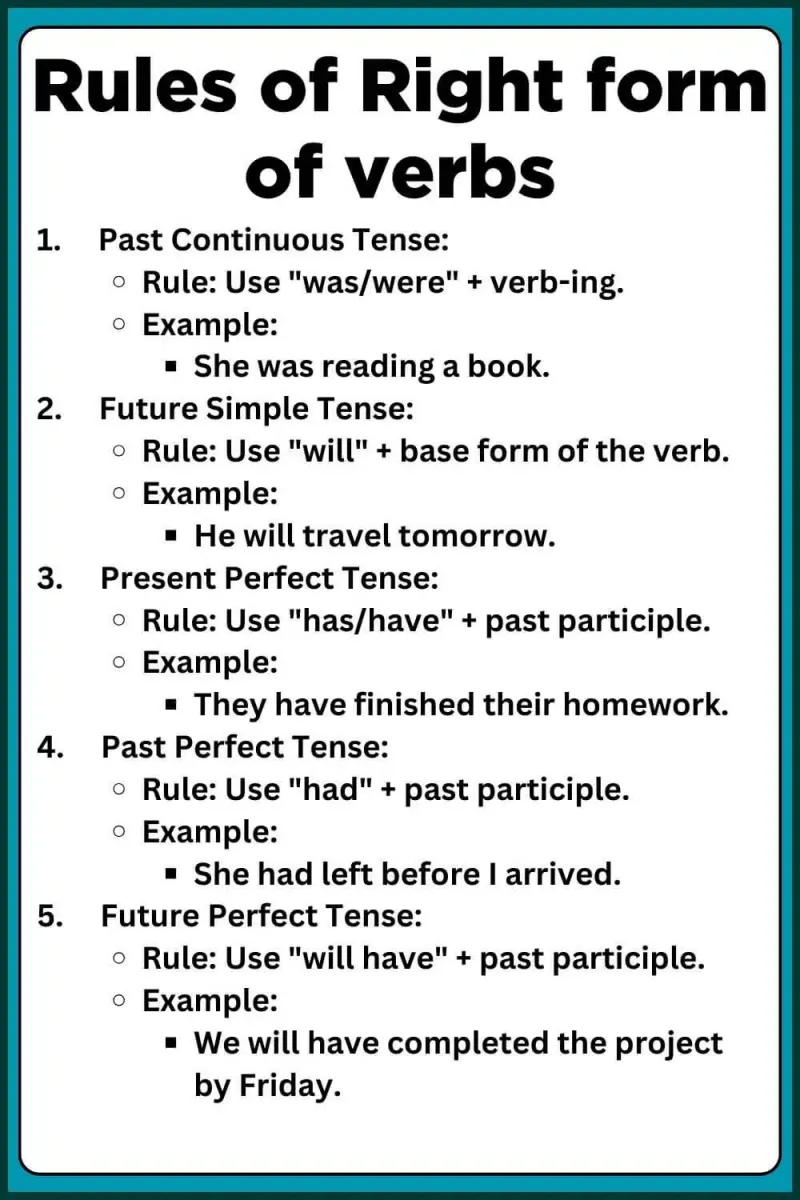
The right form of verb encompasses most of the grammatical rules of English language. Every element of a sentence eventually relates to the verb. The verbs appear differently in a sentence on the basis of their subjects (subject-verb agreement), tenses, moods, voices, different structures, modals, etc.
Right form of verb-এর৪০টিনিয়মঃ
1. Sentence যদি Present indefinite tense হয়এবং Subject যদি Third Person singular number হয়, তবে verb-এরসঙ্গে s/es যুক্তহয়।যেমন:
# The baby (cry).
Ans.: The baby cries.
--------------------------------
2. Before দ্বারাদুটি Past tense যুক্তথাকলে before-এরআগেরঅংশে Past perfect tense এবংপরেরঅংশ Past indefinite tense হয়।যেমন:
We (reach) our school before the bell rang.
Ans: We had reached our school before the bell rang.
The patient had died before the doctor (come).
Ans: The patient had died before the doctor came.
--------------------------------
3. After দ্বারাদুটি Past tense যুক্তথাকলেএরআগেরঅংশ Past indefinite tense এবংপরেরঅংশ Past perfect tense হয়। যেমন:
They arrived the station after the train (leave).
Ans.: They arrived the station after the train had left.
The patient (die) after the doctor had come.
Ans.: The patient died after the doctor had come.
4. No sooner had ............. than,
5. Scarcely had .......... when,
6. Hardly had .......... when—প্রথমঅংশ Past perfect tense অনুযায়ীহয়, অর্থাৎ verb-এর Past participle form হবে।দ্বিতীয়অংশ Past indefinite tense অনুযায়ীহয়, অর্থাৎ verb-এর Past form হয়। যেমন:
No sooner had the bell (ring) than the teacher (enter) the
classroom.
Ans.: No sooner had the bell rung than the teacher entered the classroom.
Scarcely had he (arrive) at the bus stand when the bus (leave).
Ans.: Scarcely had he arrived at the bus stand when the bus left.
7. সাধারণত since দ্বারাদুটি clause যুক্তথাকলেএবং since-এরআগেরঅংশ Present indefinite/Present perfect tense হলেপরেরঅংশ Past indefinite tense হয়। যেমন:
It is many years since he (give) up smoking.
Ans.: It is many years since he gave up smoking.
Five years have passed since he (leave) the house.
Ans.: Five years have passed since he left the house.
8.আবার since দ্বারা clause যুক্তথাকলেএবং since-এরআগে clause বাবাক্যেরঅংশ Past indefinite tense হলেপরেরঅংশ verb -এর Past perfect tense হয়। যেমন:
Many years passed since I (meet) him last.
Ans: Many years passed since I had met him last.
It was many years since I (visit) there.
Ans: It was many years since I had visited there.
9. Passive voice-এসর্বদা verb-এর past participle form হয়।
যেমন: This work was (do) by him.
Ans.: This work was done by him.
The problem has been (solve) by him.
Ans.: The problem has been solved by him.
The school was (close) for sine die.
Ans.: The school was closed for sine die.
10. Simple sentence-এদুটি verb থাকলেদ্বিতীয় verb-এরসঙ্গে ing যোগহয়অথবাদ্বিতীয় verbটিরআগে to বসে।
যেমন: He saw the boy (play) in the field.
Ans.: He saw the boy playing in the field.
I heard him (speak).
12. Note : দ্বিতীয় verbটিযদিউদ্দেশ্যবোঝাতেব্যবহূতহয়তবেদ্বিতীয় verb-এরআগে to বসে।
যেমন: I went to the library (read) newspaper.
Ans.: I went to the library to read newspaper.
He repaired the boat (sell) it.
Ans.: He repaired the boat to sell it.
13. Modal auxiliary verb যেমন : can, could, may, might, should, would, ought to, used to, must ইত্যাদিথাকলেমূল verb-এর present form হয়।
যেমন: He can (do) it easily. Ans.: He can do it easily.
Everybody should (respect) his parents.
Ans.: Everybody should respect his parents.
It may (rain) today. Ans.: It may rain today.
14. সাধারণত sentence যদিভবিষ্যৎনির্দেশকশব্দবা phrase যেমন: tomorrow, the day after tomorrow, in future, next ইত্যাদিথাকলে future indefinite tense হবেএবং verb-এর present form বসে।
যেমন: I (go) to Dhaka tomorrow.
Ans.: I shall go to Dhaka tomorrow.
He (join) there the next day.
Ans.: He will join there the next day.
15. Sentence-এর subject singular number হলে verb singular হয়এবং subject plural হলে verb plural number হয়।
যেমন: The taste of the mangoes (to be) sour.
Ans.: The taste of the mangoes is sour.
The flowers of the garden (to be) beautiful.
Ans.: The flowers of the garden are beautiful.
These papers (to be) printed.
Ans.: These papers are printed.
16. মূল verb-এরআগে to be বা having থাকলে verb-এর past participle form হয়।
যেমন: A community centre is going to be (establish).
Ans.: A community centre is going to be established.
I do not mind (have) a cup of coffee.
Ans.: I do not mind having a cup of coffee.
He went home (have) his salary.
Ans.: He went home having his salary.
,
17.সাধারণত It is time, it is high time, wish ইত্যাদিরপরে subject ও bracket-এমূল verb থাকলে verb-এর past form হয়।
যেমন: It is time you (finish) a course on English language.
Ans.: It is time you finished a course on English language.
I wish I (sing). Ans.: I wish I sang.
আবার, It is time, it is high time-এরপরযদি bracket-এমূল verb থাকে, তবেওই verb-এরআগে to বসবেএবংওই verb অপরিবর্তিতথাকবে।
যেমন: It is time (play). Ans.: It is time to play.
It is high time (stand) by the flood-affected people.
Ans.: It is high time to stand by the flood-affected people.
18. As if, as though, wish ইত্যাদিথাকলে subject-এরপরে be verb-এরপরিবর্তে were বসে।
যেমন: He behaves as if he (be) a leader.
Ans.: He behaves as if he were a leader.
I wish I (be) a millionaire.
Ans.: I wish I were a millionaire.
19. As if, as though দ্বারাদুটি clause যুক্তথাকলেপ্রথম clauseটি Present tense হলেপরবর্তী clauseটি Past indefinite হয়।প্রথম clauseটি Past tense হলেপরের clauseটি Past perfect tense হয়।
যেমন: He behaves as if he (buy) the car.
Ans.: He behaves as if he bought the car.
He spoke as though he (do) a great task.
Ans.: He spoke as though he had done a great task.
20. While যুক্ত sentence-এ while-এরপরে verb থাকলে verb-এরসঙ্গে ing যোগহয়।আবার while-এরপরে subject থাকলে Past continuous tense হয়।
যেমন: While (take) dinner, he received the phone. Ans.: While taking
dinner, he received the phone.
While I (play) in the field, I saw him coming.
Ans.: While I was playing in the field, I saw him coming.
21. Lest দ্বারাদুটি clause যুক্তথাকলে lest-এরপরবর্তী subject-এরসঙ্গে auxiliary verb ‘should’/‘might’ বসে।
যেমন: Read attentively lest you (fail) in the examination.
Ans.: Read attentively lest you should fail in the examination.
Walk fast lest you (be) late in your class.
Ans.: Walk fast lest you might be late in your class.
22. Would that দ্বারা sentence শুরুহলে subject-এরপরে could বসেএবংমূল verb-এর Present form হয়।
যেমন: Would that I (be) a bird! Ans.: Would that I could be a bird!
Would that I (visit) Cox’s Bazar .
Ans.: Would that I could visit Cox’s Bazar.
23. সাধারণত each, one of, every, either, neither ইত্যাদিদ্বারাকোনো subject গঠিতহলেসেটি third person singular number হয়।তাইএদেরপরের verbটিও singular number হয়।
যেমন: Each boy (come) here. Ans.: Each boy comes here.
Everybody (wish) to be happy. Ans.: Everybody wishes to be happy.
24. Adjective-এরআগে the বসলে subjectটি plural হয়এবংতদনুযায়ী verb বসে।
যেমন: The virtuous (to be) blessed.
Ans.: The virtuous are blessed.
The poor (live) from hand to mouth.
Ans.: The poor live from hand to mouth.
25. Titles, names, phrase of measurement দেখতে plural হলেও singular verb হয়।
যেমন: Thirty miles (to be) a long way.
Ans.: Thirty miles is a long way.
Star Wars (to be) an excellent movie.
Ans.: Star Wars is an excellent movie.
Eight hours (to be) a long time to work.
Ans.: Eight hours is a long time to work.
26. কোনো sentence ‘It’ দ্বারাশুরুহলেপরবর্তী verb singular হয়।
যেমন: It (to be) difficult to do.
Ans.: It is difficult to do.
It (to be) you who have done this.
Ans.: It is you who have done this.
27. কোনো sentence যদি introductory there দ্বারাশুরুহয়এবংতারপর singular number থাকে, there-এর singular verb হয়।আরযদি there-এরপরে plural number থাকেতবে plural verb হয়।
যেমন: There (to be) a big river beside our village.
Ans.: There was a big river beside our village.
There (to be) a lot of work left for us.
Ans.: There were a lot of work left for us.
28. Let, had better, had rather, would better, would rather ইত্যাদিথাকলে form বসে।
যেমন: I would rather die than (beg) .
Ans.: I would rather die than beg.
Would you let me (go) there?
Ans.: Would you let me go there?
29. If যুক্ত clause-এরপ্রথমঅংশ Present indefinite tense হলেপরেরঅংশ Future indefinite হয়, অর্থাৎ structureটিহয় ‘If + Present + Future'
যেমন: If you work hard, you (prosper) in life.
Ans.: If you work hard, you will prosper in life.
30. If-যুক্ত clause-এরপ্রথমঅংশ Indefinite tense হলেপরেরঅংশে subject-এরপরে would/could/might বসেএবং verb-এর Present form হয়।অর্থাৎ, structureটিহয় ‘If + Past indefinite’ (Subject + would/could/might + verb-এর Present form)।
যেমন: If he agreed, I (give) the money.
Ans: If he agreed, I would give the money.
If you studied, you (get) a good result.
Ans: If you studied, you would get a good result.
If they tried, they (succeed).
Ans.: If they tried, they would succeed.
31. If-যুক্ত clause-এরপ্রথমঅংশ Past perfect tense হলেপরেরঅংশে subject-এরপরে would have/could have/might have বসেএবং verb-এর Past participle form হয়।
যেমন: If you had finished it sincerely, you (get) a profit. Ans.: If
you had finished it sincerely, you would have got a profit.
If I had possessed vast wealth, I (help) the poor people.
Ans.: If I had possessed vast wealth, I would have helped the poor people.
32. To ব্যাতিত preposition-এরপরের verb-এরসঙ্গে ing যুক্তহয়।
যেমন: He is now engaged in (read).
Ans.: He is now engaged in reading.
One can gather knowledge by (travel).
Ans.: One can gather knowledge by traveling.
33. Can not help, could not help, look forward to, with a view to, get used to, mind ইত্যাদিরপরে verb-এরসঙ্গে ing যুক্তহয়।
যেমন: He came to Dhaka with a view to (find) a job.
Ans.: He came to Dhaka with a view to finding a job.
I cannot help (laugh).
Ans.: I cannot help laughing.
34. কোনো sentence-এরশুরুতে subject-এরস্থানে verb থাকলে verb-এরসঙ্গে ing যোগহয়।
যেমন: (To swim) is a good exercise.
Ans.: Swimming is a good exercise.
(To speak) is an art.
Ans.: Speaking is an art.
35. If-যুক্ত clause-এরপ্রথমটিতে subject-এরপর were থাকলেদ্বিতীয়অংশে subject-এরপরে would/could/ might বসেএবং verb-এর Present from বসে।আবার, would have/could have/would have-ওবসতেপারে।সেক্ষেত্রে verb-এর Past participle form বসে।
যেমন: If I were an artist, I (draw) a nice picture.
Ans: If I were a artist, I would draw a nice picture.
If I were a billionaire, I (establish) a hospital for the poor.
Ans.: If I were a billionaire, I would establish a hospital for the poor.
36. Had-এরপরে subject এবং verb-এর Past participle থাকলেপরবর্তী clause-এর subject-এরপরে would have/could have/might have + verb-এর Past participle form বসে।
যেমন: Had I been a teacher, I (talk) the real story to my students.
Ans.: Had I been a teacher, I would have talked the real story to my students.
37. Verb ‘to be’-বিহীন sentence-কে negative বা interrogative করতেহলে tense ও subject-এর number ও person অনুসারে do, does, did ব্যবহারকরতেহবে।
যেমন: We not (play) Ha-du-du.
Ans.: We do not play Ha-du-du.
She not (play) football.
Ans.: She does not play football.
38. সাধারণত preposition—on, in of, for, from, by, after at, beyond, upon, against, with, without, before ইত্যাদি—এরপরে verb-এরসঙ্গে ing যোগহয়।
Rina is busy in (do) her homework.
Ans.: Rina is busy in doing her homework.
Keep on (try) hard.
Ans.: Keep on trying hard.
39. Interrogative sentence যদি who, what, why, which, when, where, whose, how ইত্যাদি question word দ্বারাশুরুহয়, তাহলে subject-এরআগে tense ও person অনুযায়ী auxiliary verb ব্যবহারকরতেহবে।
Why he (look) so happy?
Ans.: Why does he look so happy?
When father (come)?
Ans.: When will father come?
40. সাধারণতনিচেলিখিত verb-গুলোরপরে gerund বসে।যেমন: admit, enjoy, report, appreciate, finish, recent, avoid, mind, resist, miss, resume, consider, postpone, risk, delay, practice, suggest, escape, imagine, save, recall, prevent, propose, stop, deny, quit ইত্যাদি।
We enjoy (watch) TV.
Ans.: We enjoy watching TV.
I have finished (writing).
Ans.: I have finished writing.