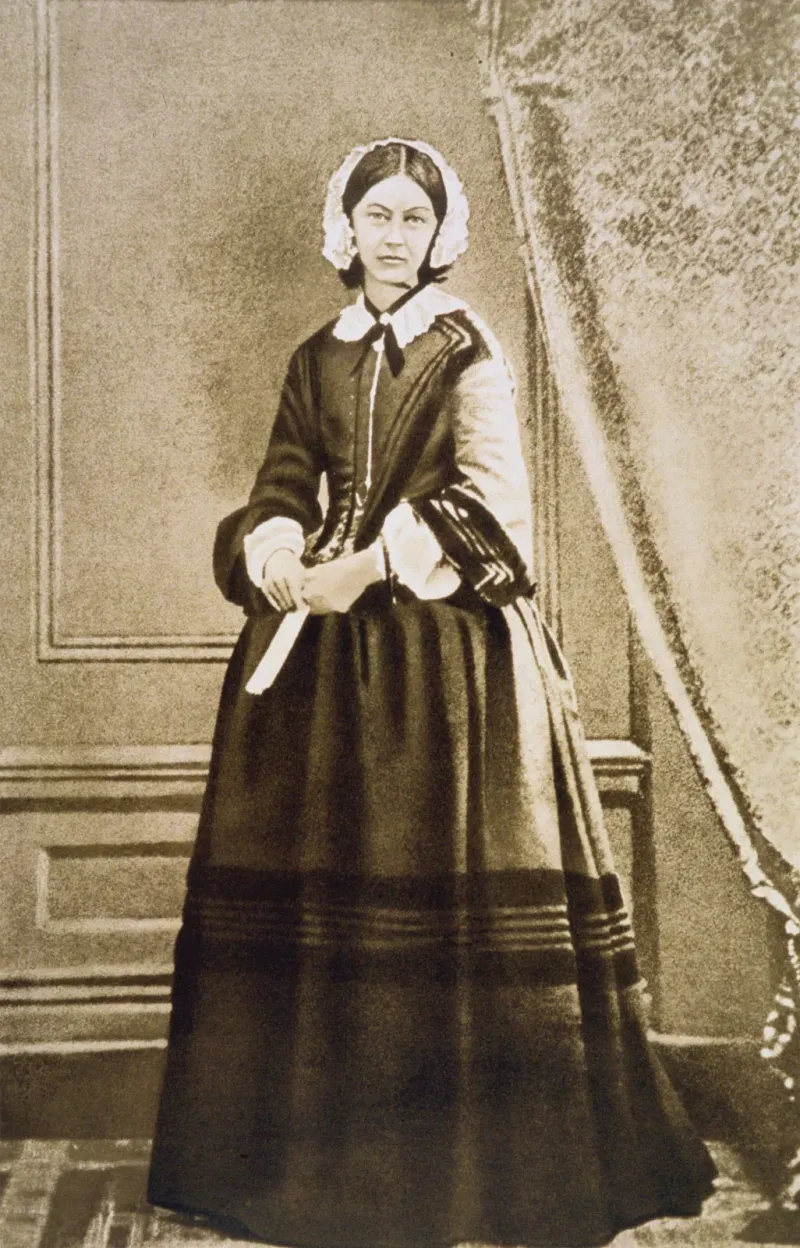
Florence Nightingale was a pioneering British nurse, social reformer, and statistician who is universally recognized as the founder of modern nursing. Born into a wealthy, upper-class English family on May 12, 1820, in Florence, Italy (after which she was named), she famously defied Victorian societal expectations to pursue a life of service. She rose to global prominence during the Crimean War, where her revolutionary approach to sanitation drastically reduced soldier mortality rates, earning her the iconic moniker "The Lady with the Lamp".
Early Life and "Divine Calling"
- Privileged Upbringing: Raised on wealthy family estates in Derbyshire and Hampshire, England, Florence was highly educated by her father. She excelled unusually for a woman of her era in mathematics, philosophy, history, and multiple languages.
- A Higher Purpose: At age 16, she experienced the first of several "calls from God," convincing her that her divine purpose was to reduce human suffering.
- Defying the Family: In Victorian England, nursing was considered a low-status, menial job often associated with poor hygiene and loose morals. Her parents fiercely opposed her ambitions and expected her to marry well, but Florence turned down prominent marriage proposals to remain focused on her mission.
- Formal Training: In 1851, her father finally relented, allowing her to undergo formal nursing training at the Institution of Protestant Deaconesses in Kaiserswerth, Germany. By 1853, she became the superintendent of a women's hospital on Harley Street in London.
The Crimean War (1854–1856)
- Horrific Conditions: When the Crimean War broke out, reports surfaced of horrific, unsanitary conditions at the British military hospital in Scutari (modern-day Istanbul). More soldiers were dying from infectious diseases like cholera and typhus than from battle wounds.
- Sanitation Reforms: In 1854, Nightingale led a team of 38 volunteer nurses to Scutari. She immediately enforced strict hygiene protocols: scrubbing the wards, introducing clean linens, improving ventilation, and establishing a functional kitchen for patient diets.
- Dramatic Results: Her systemic sanitary interventions spectacularly reduced the hospital's death rate from roughly 42% down to just 2%.
- The Lady with the Lamp: Nightingale earned her immortal nickname because she spent hours making solitary rounds through the dark hospital corridors at night, moving from bed to bed with a lantern to comfort wounded soldiers.
Later Reforms and Statistics
- Data Visualization Pioneer: Nightingale was a brilliant mathematician. To prove to government officials that poor sanitation was killing soldiers, she invented the "polar area diagram" (or Rose Diagram), a precursor to the modern pie chart. Because of this groundbreaking work, she became the first female member of the Royal Statistical Society in 1858.
- Professionalizing Nursing: In 1860, using funds donated by a grateful public, she established the Nightingale Training School for Nurses at St. Thomas' Hospital in London. This institution transformed nursing from a looked-down-upon task into a highly structured, respected, and scientific medical profession.
- Prolific Writer: She published over 200 books, reports, and pamphlets. Her 1859 book, Notes on Nursing: What It Is, and What It Is Not, serves as the foundational text for modern healthcare practices.
Death and Lasting Legacy
- Final Years: Nightingale contracted "Crimean fever" during the war and spent much of her later life chronically ill and bedridden. Despite this, she continued to consult on healthcare reform, hospital design, and public health policies globally for decades via correspondence.
- Historical Honors: In 1907, King Edward VII presented her with the Order of Merit, making her the first woman ever to receive the prestigious award.
- Passing: Florence Nightingale died peacefully in her sleep in London on August 13, 1910, at the age of 90. In accordance with her wishes, her family turned down a grand state burial at Westminster Abbey, opting for a quiet, modest funeral.
- Global Remembrance: Her legacy is honored annually on her birthday, May 12, which is celebrated worldwide as International Nurses Day.
If you are researching a specific area of her life, please let me know. I can share more about her mathematical data charts, details about her work in the Crimean War, or her impact on modern hospital designs.