
ড. মোঃ হুমায়ুন কবীর
সহকারী অধ্যাপক
০৪ জুন, ২০২৬ ১১:০৪ পূর্বাহ্ণ
সহকারী অধ্যাপক
A NEW HORIZON OF EDUCATION: SYNERGY OF AI AND TEACHERS IN BLENDED LEARNING.
Dr. Md. Humayun Kabir
Blended Learning: Blended learning is an approach to education that combines online educational materials and opportunities for interaction online with traditional place-based classroom methods. It requires the physical presence of both teacher and student, with some elements of student control over time, place, path, or pace.
Type of Blended Learning Models: There is little consensus on the definition of blended learning. Some academic studies have suggested it is a redundant term. However, there are distinct blended learning models suggested by some researchers and educational think-tanks. These models include-
* Face-to-face driver
* Rotation
* Flex
* Labs
* Self-blend
* Online driver
Educational Architect: In the traditional system, the teacher was the sole source of information. But in the era of AI, the role of the teacher has changed to "learning facilitator" or "architect of education". Teachers now create a learning environment and guidance tailored to each student with the help of AI, which makes education more meaningful and effective.
Image: Teacher is the true learning architect.
The Role of AI: Artificial intelligence helps personalize blended learning by analyzing student data, making it easier for teachers to see where each student struggles or excels. Instead of changing the curriculum, AI changes how a teacher manages both online and in-person classrooms at the same time. However, this shift brings real challenges, including algorithmic bias, data privacy issues, and unequal access to technology among students that schools must address.
Image:By analyzing student data, AI helps teachers understand the strengths and weakness of each student.
Personalized Learning Guide: Usually, there is a single lesson plan for all students in a class, which often doesn't work for everyone. Teachers can now use AI to create differentiated instruction based on the talents of different students.
AI-powered Instruction-
* Identify student weaknesses and provide special attention.
* Assign course materials at a personalized pace.
* Create special assignments for students who are lagging behind.
Data Analysis and Progress: Data analysis and progress are deeply intertwined. Without analysis, progress is just guesswork; without a goal of progress, data analysis lacks direction. Together, they form a continuous loop that transforms raw numbers into meaningful advancement. Here is how data analysis directly drives and measures progress across any learning progress.
Graph:
The graphic shows how the use of AI and learning analytics increases
teacher and student engagement and success rates in the classroom
manifold.
Co-designer of the Lesson Plan: In blended education, AI serves as an active collaborator in curriculum development rather than a basic text generator. Designing these courses requires aligning independent online modules with in-person classroom sessions. Utilizing AI to organize these structural components allows educators to focus their efforts on personalizing the learning experience and supporting students directly.
Curriculum Mapping: AI instantly aligns learning objectives with standards like Bloom’s Taxonomy or Webb's Depth of Knowledge.
Content curation: AI suggests various excellent resources. The teacher's responsibility is to select the most useful and accurate information from that content for the class.
Maintaining balance: Creating a balanced combination between online and offline learning. Students will acquire basic knowledge through online and the teacher will practice hands-on in face-to-face classes.
Immediate correction: AI monitors the feedback given by students. Teachers can immediately change and enrich their teaching strategies by viewing this real-time data.
Creative Brainstorming: AI recommends unique hooks, real-world analogies, and interactive activities to spark student engagement.
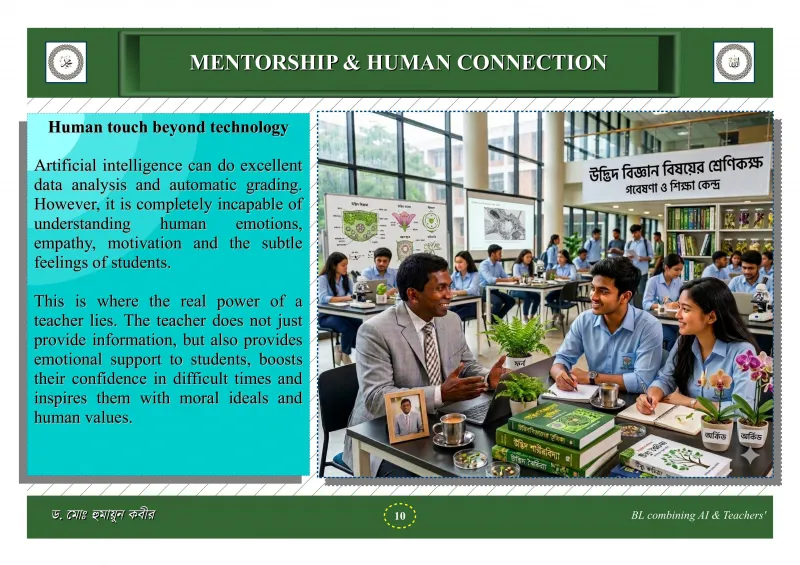
Mentorship & Human Connection: Artificial intelligence can do excellent data analysis and automatic grading. However, it is completely incapable of understanding human emotions, empathy, motivation and the subtle feelings of students.
This is where the real power of a teacher lies. The teacher does not just provide information, but also provides emotional support to students, boosts their confidence in difficult times and inspires them with moral ideals and human values.
Image: The teacher's core strength - being fully capable of understanding the human emotions, generosity, compassion, inspiration, and subtle feelings of students.
Ethical Ai and Digital Literacy: Integrating AI into blended learning is incredibly exciting, but this is the exact intersection where things get complicated. It is easy to marvel at how fast an AI can generate a quiz, but far more challenging to ensure that using it doesn't compromise student privacy, reinforce historical biases, or turn students into passive consumers of unverified information.
True digital literacy is no longer just about knowing how to search Google or format a document—it is about navigating the complex, often opaque ethics of algorithmic systems.
Teaching Ethical and Responsible Behavior: Students should avoid plagiarism in using AI and see AI tools as a form of helping to develop their own intelligence.
Critical Thinking: Not every result obtained from AI may be completely accurate. Students should be taught to judge with reason rather than blindly believing it.
Information Security and Awareness: Students should follow cybersecurity rules and ensure the protection of their personal information while working on online platforms.
Change in Professional Skills: The takeaway- The learning curve can feel steep, but the goal of upskilling isn't to force educators to think like computers. It is exactly the opposite: offload the computational and administrative tasks to the machines so educators can focus 100% of their professional energy on being deeply human guides
Graph:
The graph shows how the importance of mentoring and AI-based
decision-making has increased dramatically as administrative
complexity has decreased.
Scientific Redistribution Model of Teacher Working Hours: The Scientific Redistribution Model of Teacher Work Hours is a systematic framework that helps teachers reduce their workload and improve the quality of education. It not only allocates time for teaching in the classroom, but also for lesson planning, assessment, and administrative work.
* Psychological one-to-one mentorship and feedback (50%)
* Teaching strategies and adaptive content curation (30%)
* Automated evaluation and administrative coordination (20%)
Key Benefits: When we synthesize the integration of AI within a blended learning framework, the advantages ripple across everyone involved. It fundamentally optimizes the relationship between independent online preparation and highly collaborative, in-person execution. Here is the definitive breakdown of the macro-level benefits:
*
Cost-effectiveness.
* Consistency.
* Real-time Access.
* Greater retention.
* Facilitates training feedback.
* Provides personalized training experience.
* Data tracking is more quick and convenient.
What Support Do Teachers' Need? For AI to truly act as a helpful co-designer in a blended learning ecosystem, teachers cannot be left to figure it out alone in their spare time. They need a deliberate, multi-layered support infrastructure. 5 things teachers can do to improve online teaching-
1. Utilize a variety of technology option.
2. Connect to student individually.
3. Prepare to work with parents.
4. Consider new learning methods.
5. Provide collaboration and socialization opportunities methods.
5-Year Implementation Roadmap: Transforming an educational institution from a traditional learning model into an AI-enhanced blended ecosystem cannot happen overnight. It requires a structured, phased approach that prioritizes ethical security and teacher mastery before scaling to full student integration.
This strategic 5-year roadmap provides a scalable timeline to transition an institution from baseline exploration to full algorithmic maturity.
* 1st Year (2026): Pilot program launched, AI model training and content development
* 2nd Year (2027): Nationwide special digital literacy and AI training workshops for teachers started.
* 3rd Year (2028): Ensure pre-primary classroom rollout in selected schools at the upazila level.
* 4th-5th Year: Establish school network across the country and launch AI platform on the National Education Grid.
Implementation Challenges: The most meticulously planned 5-year roadmap will hit significant friction when theory meets the reality of a live college system. Implementing AI within a blended learning framework is incredibly complex because it demands simultaneous changes from teachers, students, administrators, and IT infrastructures. Understanding these roadblocks early is the only way to build a resilient, long-term strategy.
The Takeaway- Technology is rarely the bottleneck; human management and public policy are. A successful AI rollout is roughly 20% software integration and 80% cultural change management.
Graphic:
Top 5 Challenges of Using AI in Education
Infographic: The provided infographic, titled "New Horizons in Education: Combining AI and Teachers in Blended Learning" is a visual summary of the core concepts we have explored throughout this discussion. It illustrates how artificial intelligence acts as an interactive bridge connecting a student's independent digital work with an educator's face-to-face instruction.
Infographic- New Horizons in Education: Combining AI and Teachers in Blended Learning.





৫
৫ মন্তব্য